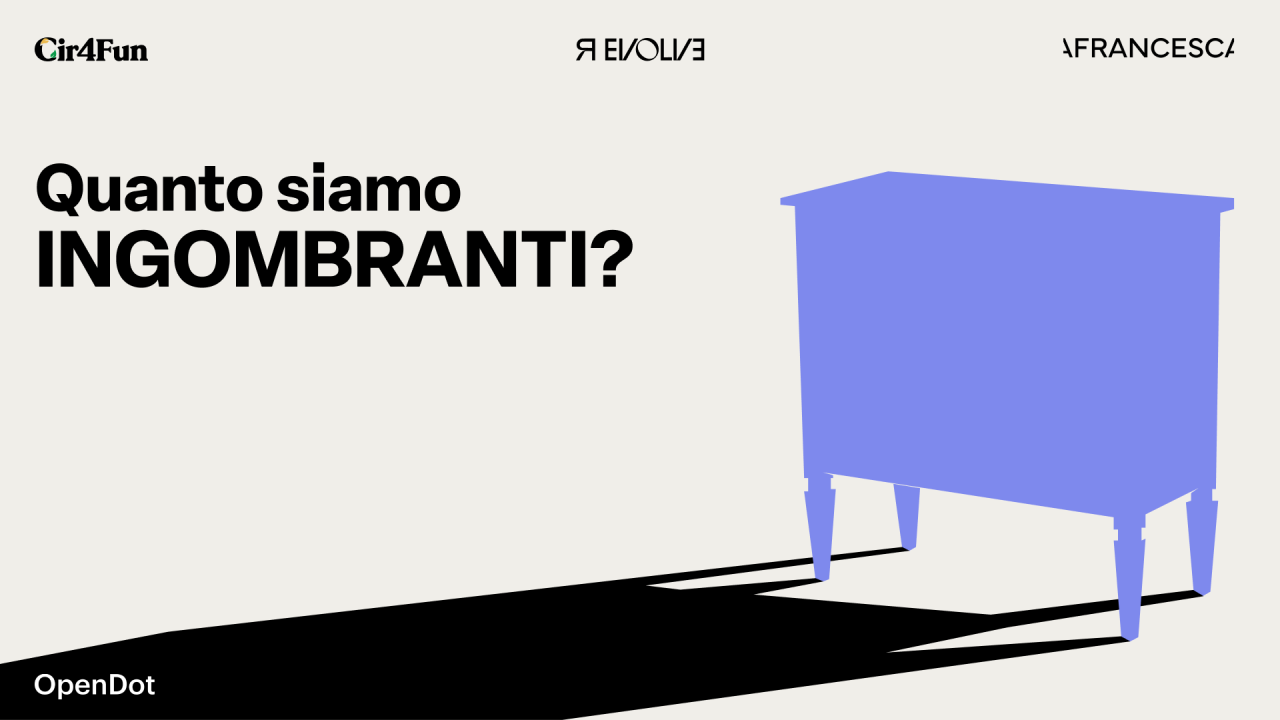
How bulky are we?
An open discussion on the furniture supply chain and the challenges of circularity
2026
Education and Civic engagement, Circular Economy
Cir4Fun
R-evolve
FRANCESCA
Take part in the research
OpenDot, as a partner of CIR4FUN, together with the Politecnico di Milano and the University of Florence, partners of R-EVOLVE, has developed a questionnaire for end users to understand behaviors related to bulky waste.
The results will help shape future activities and initiatives within the projects.
Share your perspective by filling out the questionnaire:
How bulky are we?
The event:
On April 20 from 10 a.m. to 12 p.m., to kick off Fuorisalone, OpenDot organized an open and participatory discussion focused on the impact of the furniture supply chain and the challenges of the circular transition.
A dialogue without a stage, but with many voices, created to bring together around the same table those who, every day, engage with the furniture sector from different yet complementary perspectives: production, design, distribution, research, institutions, and end-of-life management. An ecosystem of expertise necessary to collectively reflect on the supply chain’s impact, from raw materials to disposal, and to try to build a shared vision of change.
The initiative falls within three projects of the Horizon Europe program—Cir4Fun, R-evolve, and FRANCESCA—which operate on the same level of supply chain transformation but from different and complementary perspectives. These projects are designed to test and adopt innovative tools and models that converge toward a single goal: transforming the furniture sector in a circular, systemic, and measurable way.
It is precisely this scenario that gives rise to the question guiding our discussion: just how much of a burden are we?
We’ve all asked ourselves this at some point in our lives, but answering this question isn’t easy. Especially if, in asking it, we truly want to make a difference.
Because when it comes to impact, sustainability, and circularity, it’s true that every small action counts, but it is the system as a whole that must drive change.
What does “bulky” mean?
In the furniture sector, “bulky” is not just an adjective: it refers to all that large-scale household waste—chairs, tables, wardrobes, sofas, mattresses—that cannot be disposed of through regular collection and requires dedicated channels for pickup, reuse, or disposal.
Every piece of furniture thrown away reflects a choice: to discard, repair, transform, or put back into circulation. The furniture sector contributes significantly to urban waste, involving mixed materials that are difficult to separate, large volumes to transport, and items that are often still functional. This is why reuse represents a concrete solution: it extends the life of products, reduces waste, and limits the demand for new resources.
The stakeholders involved
- AMSA — Antonio Bisignano, Direttore Marketing
- Arper — Andrea Mulloni, Sustainability Manager
- Comune di Milano — Serena Pelagallo, Direzione di progetto Economia Urbana, Moda e Design
- Di Mano in Mano — Massimiliano Besana, Direttore Marketing
- FederlegnoArredo — Omar Degoli, responsabile ambiente e circolarità
- Fondazione Symbola — Domenico Sturabotti, Direttore
- LAGO — Claudio Cachero, Technical Department Manager
- Matteo Ragni Design Studio — Matteo Ragni, Designer
- OpenDot — Alessandro Masserdotti, Founder
- Politecnico di Milano (POLIMI) — Prof. Francesco Zurlo, Preside della Scuola del Design, Politecnico di Milano
- Pozzi Arturo S.p.A — Matteo Pozzi, Sales Director & Sustainability Expert
- Rilegno — Elena Lippi, Direttrice Comunicazione e Sostenibilità
- Riqualta — Gino Schiona, Consorzio Nazionale Sistema Arredo
- SARA — Igor Saglini, CEO
- SCM Group — Luca Bergantini, Business Unit Manager
- Sovrappensiero Design Studio — Lorenzo De Rosa ed Ernesto Iadevaia, Titolari
- Università degli Studi di Firenze (UNIFI) — Prof. Giuseppe Lotti, Presidente della scuola di Architettura, Università di Firenze
- Valcucine — Daniele Prosdocimo, Marketing Manager
But there were also many passionate individuals and students who were engaged by the topics under discussion and shared their ideas, experiences, and perspectives, contributing to a rich and necessary discussion.
A circular living room
To ensure consistency between its message and its actions, OpenDot chose to collaborate with Di Mano in Mano, furnishing the event space—and in particular the circular lounge that hosted speakers and the audience—with existing vintage and designer seating.
A practical choice, but also a symbolic one: to demonstrate that what is already in circulation can continue to have value, function, and beauty. Rethinking our relationship with objects also means learning to view them in a new light.
Special thanks to Di Mano in Mano for sharing their vision, objects, and possibilities with us.
A collaborative effort that looks to the future
The discussion yielded insights, questions, and sources of inspiration that will inform the research work OpenDot is conducting alongside its European partners. For us, these opportunities for dialogue are essential: they help keep the conversation open, foster connections, and enable us to continue co-designing change.
*Funded by the European Union under the GA No 101182081. Views and opinions expressed are however those of the author(s) only and do not necessarily reflect those of the European Union or European Research Executive Agency (REA). Neither the European Union nor the granting authority can be held responsible for them.